
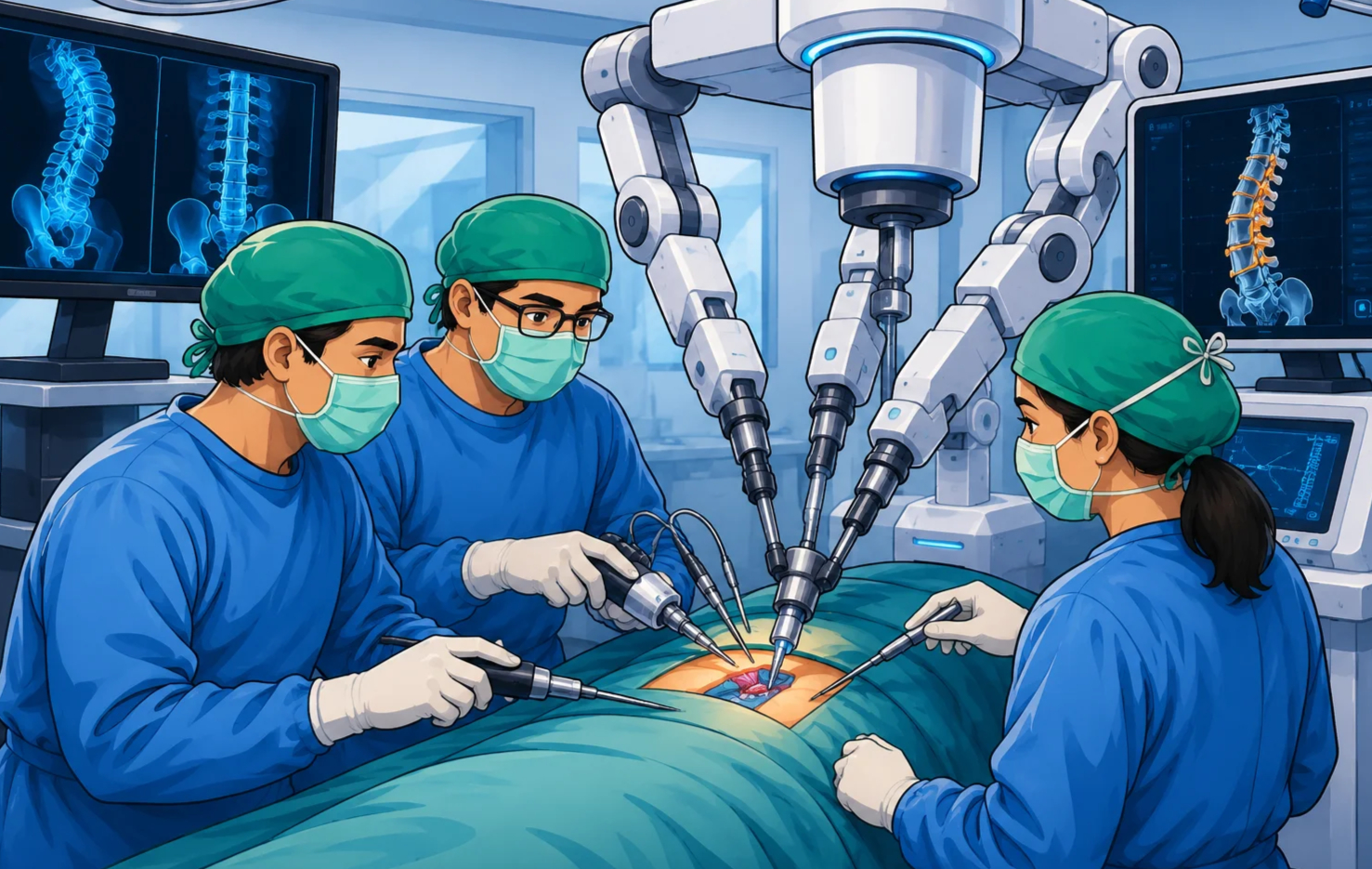
A public hospital in rural Sindh just gave Pakistan’s healthcare sector a genuine medical breakthrough to talk about. The Gambat Institute of Medical Sciences (GIMS) — formally the Pir Abdul Qadir Shah Jeelani Institute of Medical Sciences — announced in early July 2026 that its surgical team had completed the country’s first semi-active robotic spine surgery, a neurosurgical milestone officials are calling a turning point for advanced spine surgery access in Pakistan.
For years, patients who needed this level of precision spine care often had to travel abroad or turn to a small number of private hospitals in major cities. This milestone starts to change that equation, at least for patients across Sindh and the surrounding region. Here’s what semi-active robotic spine surgery actually involves, how the procedure at GIMS came together, why it matters, and what still stands in the way of scaling this kind of healthcare innovation in Pakistan.
What Is Semi-Active Robotic Spine Surgery?
Semi-active robotic spine surgery uses a robotic arm to hold a precise, pre-planned trajectory based on a patient’s imaging, while the surgeon manually places screws, rods, or other spinal hardware along that guided path. The robot doesn’t operate on its own — it supports the surgeon’s hands rather than replacing them.
Robotic spine systems generally fall into three categories, depending on how much of the physical work the machine actually performs.
Active vs. Semi-Active vs. Passive Robotic Systems
- Active systems carry out certain pre-planned movements largely on their own, under close surgeon supervision.
- Semi-active systems — the category used in this procedure — hold a fixed position or trajectory for the surgeon to work through, without moving independently.
- Passive or navigation-only systems simply display real-time positioning data on a screen, without physically guiding the surgeon’s instruments at all.
In practice, semi-active robotic spine surgery sits in a useful middle ground. It adds a level of mechanical steadiness and accuracy that’s difficult to match freehand, while the surgeon keeps full manual control of the procedure itself. That balance is part of why hospitals consider it well-suited to complex, high-risk neurospine cases.
Inside Pakistan’s First Semi-Active Robotic Spine Surgery
The procedure was led by Dr. Pir Asad Aziz, GIMS’s Head of Robotic Neurospine Surgery, working alongside the rest of the institute’s surgical team. Hospital spokesperson Jameel Haider framed the surgery as more than a single success story — in his telling, it’s evidence of what the Sindh government’s ongoing healthcare investment is starting to produce on the ground, not just an isolated technical feat.
Dr. Rahim Bux Bhatti, who directs GIMS, put the reasoning in more practical terms: robotics exist at the hospital to cut down risk during difficult spine operations and to push the institute’s overall care quality closer to what’s available at top-tier facilities elsewhere.
GIMS’s official statement also named three senior figures as backers of the effort — Sindh Chief Minister Syed Murad Ali Shah, Sindh Health Minister Dr. Azra Fazal Pechuho, and PPP leader Bilawal Bhutto Zardari — tying the surgery to the province’s broader health-spending priorities. One thing GIMS hasn’t shared publicly: specifics about the patient’s condition or which exact robotic platform was used. If the hospital releases that information later, it would add real clinical weight to the story.
Why This Medical Breakthrough Matters for Pakistan’s Healthcare System
This isn’t simply a story about one hospital acquiring new equipment. GIMS sits in Gambat, a taluka in Khairpur District that serves roughly 300,000 people directly, plus patients referred in from upper Sindh, lower Punjab, and parts of Balochistan. It’s also a public-sector institution, not a private hospital reserved for patients who can afford premium fees.
That combination matters. Access to advanced spine surgery has historically been limited to a small number of urban centers in Pakistan. Karachi’s Sindh Institute of Urology and Transplantation (SIUT) has run a robotic surgery program since 2011, and a handful of private hospitals in cities like Lahore have added robotic-assisted procedures more recently. Rural, public hospitals have largely been left out of that expansion, mostly because of cost.
By bringing semi-active robotic technology to a rural, public-sector hospital, GIMS is offering proof that healthcare innovation in Pakistan doesn’t have to stay confined to big cities and big budgets — a point provincial officials were quick to highlight in their own statements on the achievement.
Benefits of Semi-Active Robotic Surgery for Spine Patients
According to GIMS, the shift to semi-active robotic technology is expected to bring several concrete advantages to complex spine procedures: greater precision, reduced blood loss, lower postoperative pain, fewer complications, and faster recovery times. These are the same general benefits associated with robotic-assisted spine surgery internationally, though real-world outcomes always depend on the patient, the surgical team, and the specific procedure performed.
Semi-Active Robotic Surgery vs. Traditional Open Surgery
| Factor | Traditional Open Spine Surgery | Semi-Active Robotic Spine Surgery |
|---|---|---|
| Incision size | Larger incisions for direct visibility | Smaller, minimally invasive incisions in most cases |
| Surgical guidance | Surgeon’s manual technique and visual judgment | Robotic arm holds a pre-planned trajectory to follow |
| Blood loss | Typically higher | Generally lower, per hospital reporting |
| Hospital stay | Often longer | Frequently shorter |
| Preoperative planning | Standard imaging review | Detailed CT/MRI-based trajectory planning built into the robotic system |
These are widely cited general trends in robotic-assisted spine surgery, not confirmed clinical statistics for this specific case. GIMS has not yet published detailed outcome data from the procedure.
How Robotic Spine Surgery in Pakistan Is Evolving
Robotic surgery is still a young field in Pakistan. The country’s first robotic surgical system, a Da Vinci platform, was installed in 2011 at Sindh Government Qatar Hospital in Karachi, mainly for urology and general surgery. SIUT in Karachi has since expanded its robotic program substantially and added a UK-built CMR Surgical robot to its lineup. A small number of private hospitals, including facilities in Lahore, have introduced robotic-assisted procedures of their own over the past few years.
Robotic spine surgery specifically has lagged behind general robotic surgery adoption — partly because spine-specific robotic platforms remain a newer, narrower niche even in global markets, and partly because of the same cost barriers slowing robotic adoption across Pakistan’s healthcare system as a whole. GIMS’s announcement brings robotic neurospine care into that conversation for the first time, and hospital administrators say they intend to keep expanding the program rather than treat this as a one-off achievement.
Challenges Facing Advanced Spine Surgery in Pakistan
Robotic spine surgery isn’t about to become routine across Pakistan overnight. Cost remains the biggest obstacle — a single robotic surgical platform can cost hundreds of millions of rupees to install, plus significant recurring costs for maintenance and single-use surgical instruments. Specialized training is another factor, since robotic-assisted procedures require dedicated, hands-on instruction that isn’t yet widely available domestically, meaning surgical teams often need training abroad or through vendor-led programs.
GIMS has signaled this won’t be a one-time headline. Hospital leadership talks about layering more robotic capacity onto its surgical department over time, treating this milestone as a foundation for further research and training rather than an endpoint — with the broader aim of keeping more patients treated at home instead of sending them overseas for specialized care. Whether that kind of expansion reaches other public hospitals across Pakistan will likely come down to how provincial health budgets evolve over the next few years.
Frequently Asked Questions
What is semi-active robotic spine surgery?
Semi-active robotic spine surgery uses a robotic arm to hold a precise, pre-planned trajectory based on a patient’s imaging, while the surgeon manually performs the placement of screws or other spinal hardware. The robot guides; it doesn’t operate independently.
Where did Pakistan perform its first semi-active robotic spine surgery?
Pakistan’s first semi-active robotic spine (neurospine) surgery was performed at the Gambat Institute of Medical Sciences (GIMS) in Gambat, Khairpur District, Sindh.
Who led the procedure at GIMS?
Dr. Pir Asad Aziz, GIMS’s Head of Robotic Neurospine Surgery, led the operation with support from the institute’s surgical team.
Is robotic spine surgery available to the general public in Pakistan?
It’s still limited and concentrated in a small number of hospitals. GIMS’s procedure is notable because it happened at a public-sector hospital, which could widen access beyond private facilities in major cities.
What are the benefits of robotic-assisted spine surgery?
It’s generally associated with greater precision, smaller incisions, reduced blood loss, and faster recovery compared with traditional open surgery, though results vary by patient and procedure.
Conclusion: What Comes Next
Pakistan’s first semi-active robotic spine surgery is a small procedure carrying a large signal: advanced spine surgery and broader healthcare innovation in Pakistan don’t have to stay confined to private hospitals in Karachi or Lahore. A public, rural institution just showed it can lead on this front too.
Whether this becomes the start of a wider rollout or remains a well-publicized single achievement will depend on funding, training, and how provincial health authorities prioritize surgical robotics going forward. For now, it’s a genuine step forward for neurosurgical care in Pakistan.
Want more coverage of healthcare technology and innovation stories from Pakistan and beyond? Keep following Smalllnk for updates as this story develops.